
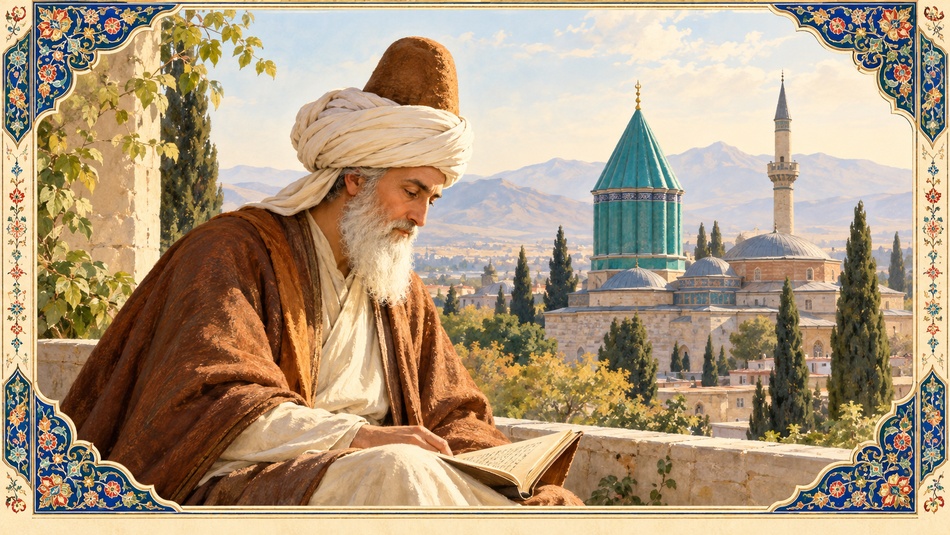
Jalal al-Din Rumi (1207–1273), commonly known as Rumi, was a Persian poet, Islamic scholar, mystic, and spiritual teacher whose poetry became one of the most influential bodies of work in Persian literature and spiritual thought. His poetry explores divine love, the human soul, longing, transformation, and the journey toward spiritual union.
Born in the cultural world of Greater Khorasan and eventually settling in Konya, Rumi began his adult life primarily as a respected religious scholar and teacher. His encounter with the wandering mystic Shams of Tabriz profoundly transformed his inner life and helped inspire an extraordinary outpouring of poetry.
More than seven centuries later, Rumi’s words continue to speak to readers across cultures and spiritual traditions. Yet understanding who Rumi really was—his historical setting, spiritual path, relationship with Shams, and Persian literary heritage—allows us to read his poetry with much greater depth.
Who Was Rumi?
Rumi was one of the great poets and spiritual figures of the Persian literary tradition. His full name is commonly given as Jalal al-Din Muhammad Rumi, and he lived during the 13th century, a period of profound political, cultural, and spiritual change across the lands of Central and Western Asia.
Although he is known around the world today primarily as a poet, Rumi was much more than a literary figure. He was educated in Islamic theology, religious law, philosophy, and spiritual teachings, and for much of his early life he was known as a scholar and teacher. Poetry eventually became one of the most powerful ways through which he expressed his spiritual experience.
Rumi composed his poetry primarily in Persian, and his poetry speaks repeatedly of Love, the Divine, the soul, separation, longing, transformation, and reunion. Rather than treating these ideas merely as abstract philosophy, he expressed them through vivid images—the Beloved, wine, music, dancing, the reed flute, the ocean, the sun, and the journey of the seeker.
The name “Rumi” itself refers to Rum, the historical name associated with the lands of Anatolia where he spent much of his life. He eventually settled in Konya, in present-day Türkiye, where he taught, composed and recited his poetry, and lived until he died in 1273.
Rumi’s Early Life and Family
Jalal al-Din Rumi was born in 1207 into a Persian-speaking family in the eastern regions of the Persian cultural world. His father, Baha al-Din Walad, was a respected religious scholar, preacher, and spiritual teacher who played an important role in Rumi’s early intellectual and religious education.
During Rumi’s childhood, his family left their homeland and traveled westward. Their journey took them through several important centers of the Islamic world before they eventually settled in Konya, in Anatolia. These travels exposed the young Rumi to a rich world of religious scholarship, Persian literature, and spiritual thought.
After his father’s death, Rumi continued his religious and intellectual training and gradually became a respected scholar and teacher himself. Before becoming the ecstatic poet recognized by readers today, he was deeply grounded in religious learning and spent years teaching and guiding students.
This background is important for understanding Rumi’s poetry. His later language of love, longing, surrender, and union did not emerge in isolation; it grew from a life already immersed in scholarship, faith, and spiritual practice.
From Scholar to Spiritual Poet
For many years, Rumi followed the path expected of a learned religious scholar. He taught students, delivered sermons, and became a respected spiritual and intellectual figure in Konya. Yet the Rumi remembered throughout the world today emerged through a profound transformation in his inner life.
A decisive moment came when Rumi encountered Shams of Tabriz, a wandering spiritual figure whose companionship deeply affected him. Their meeting challenged Rumi to move beyond knowledge understood only through study and toward a more immediate experience of divine love.
The relationship between Rumi and Shams became one of the defining experiences of Rumi’s life. In Shams, Rumi encountered a spiritual companion who awakened an intense longing for the Divine. Scholarship remained important, but Rumi’s inner world increasingly found expression through poetry, music, contemplation, and the language of love.
After Shams disappeared from Rumi’s life, Rumi’s longing and grief became powerful forces in his poetry. Rather than remaining merely personal sorrow, this separation was transformed into a spiritual language of lover and Beloved, separation and reunion, longing and union. These themes would become central to some of his greatest poetry.
Rumi and Shams of Tabriz
Rumi met Shams of Tabriz in Konya around 1244. Shams was an unconventional wandering mystic whose intense spiritual presence had a profound effect on Rumi. Their companionship drew Rumi away from the familiar boundaries of his scholarly life and toward a more direct and consuming experience of divine love.
The depth of their relationship is reflected in Rumi’s poetry. Shams became far more than the name of a spiritual companion; in Rumi’s poetic language, he could also become a mirror through which the light of the Divine was perceived. This helps explain why Rumi’s great collection of lyric poetry became known as the Divan-e Shams-e Tabrizi (Divan of Shams of Tabriz).
When Shams ultimately disappeared, Rumi experienced profound separation and longing. Yet in his spiritual journey, the search for Shams increasingly became an inward search. The beloved who seemed absent outwardly could be discovered at a deeper level within the heart.
This transformation—from seeking the beloved outside oneself toward discovering the Divine within—is essential to understanding much of Rumi’s poetry.
What Poetry and Works Did Rumi Leave Behind?
Rumi left behind an extraordinary body of Persian poetry and spiritual teaching. Much of his poetry was composed and recited orally, often in moments of spiritual inspiration, while his companions and disciples recorded his words. This oral dimension is important when approaching Rumi: the poetry was not simply a literary exercise but was deeply connected to his lived spiritual experience.
His two best-known poetic collections are the Divan-e Shams-e Tabrizi and the Masnavi-ye Ma’navi.
The Divan-e Shams-e Tabrizi, often called the Divan of Shams, is a vast collection of lyric poetry associated with Rumi’s intense experience of divine love and his spiritual relationship with Shams. Its poems frequently speak through the language of longing, ecstasy, separation, union, the Beloved, wine, music, and spiritual transformation.
The Masnavi-ye Ma’navi, commonly known simply as the Masnavi, is a monumental spiritual work consisting of six books. Through stories, reflections, teachings, and poetic illustrations, Rumi explores the human soul, our relationship with the Divine, and the inner journey toward spiritual awakening.
Rumi also left other important teachings and discourses preserved by his followers. Together, these works reveal different dimensions of the same spiritual vision: the transformation of the human being through awareness, love, and closeness to the Divine.
What Was Rumi’s Spiritual Message?
At the heart of Rumi’s spiritual message is the idea that human beings are more than the limited self they ordinarily identify with. Beneath our fears, attachments, desires, and sense of separation lies a deeper spiritual reality. For Rumi, the journey of life is ultimately a journey of awakening to that reality and returning to the Divine.
Love is central to this journey. In Rumi’s poetry, love is not limited to romantic affection. Divine Love is a transformative power that draws the human being beyond the boundaries of the ego and toward a deeper experience of truth, unity, and God.
This is why longing and separation appear so frequently in his poetry. The human soul experiences itself as separated from its origin and longs to return. One of Rumi’s most famous symbols for this condition is the reed flute, whose sorrowful sound represents the soul longing for the source from which it has been separated.
Rumi also repeatedly points inward. The spiritual seeker may search throughout the world for peace, love, truth, or the Divine, only to discover that the deepest journey takes place within. Transformation therefore requires self-awareness, surrender, and gradually moving beyond the limitations of the ego.
Rumi’s poetry does not merely describe spirituality as an idea. It invites the reader to experience transformation—to move from separation toward union, from fear toward love, and from unconsciousness toward spiritual awareness.
Why Is Love So Important in Rumi’s Poetry?
Love stands at the center of Rumi’s poetry because, for him, love has the power to transform the human being. It draws us beyond the narrow boundaries of the self and opens the heart to a greater reality.
When Rumi speaks of the lover and the Beloved, the language may sometimes sound like human romance, but its meaning often reaches far beyond romantic love. The Beloved can point toward God, Divine Beauty, or the ultimate reality for which the soul longs.
Love is therefore both a longing and a path. It reveals the pain of separation while also leading the seeker toward union. In Rumi’s spiritual vision, the lover gradually gives up attachment to the limited self and becomes increasingly absorbed in the Beloved.
This is one reason Rumi’s poetry can speak to readers on different levels. A poem may initially appear to describe human love, while a deeper reading reveals a spiritual journey toward the Divine.
Rumi’s Death and Legacy in Konya
Rumi died in Konya in 1273, leaving behind an extraordinary spiritual and poetic legacy. His death did not bring an end to the influence of his teachings. His followers and family preserved and transmitted his poetry, teachings, and spiritual tradition to later generations.
Rumi’s tomb in Konya became an important place associated with his memory and spiritual legacy. The tradition that developed among his followers eventually became closely associated with the Mevlevi order, widely known for the practice of Sama and the whirling ceremony.
Yet Rumi’s legacy extends far beyond any single institution or place. His Persian poetry has been read, recited, interpreted, and translated for centuries, carrying his spiritual vision across languages, cultures, and generations.
Today, readers around the world continue to encounter Rumi through his reflections on love, the soul, longing, surrender, and the search for the Divine. His enduring appeal lies partly in his ability to speak about profound spiritual realities through images and experiences that remain deeply human.
Why Is Rumi Still Read Today?
More than seven centuries after his death, Rumi continues to be read because the questions at the heart of his poetry remain deeply human. What is love? Who are we beyond the surface of the self? Why do we experience longing and separation? How can suffering transform us? And how can we come closer to the Divine?
Rumi approaches these questions through poetry filled with memorable images and symbols. The reed flute, the ocean and the drop, wine, the Beloved, the sun, the moon, music, and dancing give poetic form to spiritual experiences that can otherwise be difficult to express.
His poetry also speaks on more than one level. A verse about love may describe the relationship between lover and beloved while simultaneously pointing toward Divine Love. A poem about separation may express human grief while also describing the soul’s longing for its spiritual origin.
For modern readers, however, it is important to encounter Rumi within the Persian and spiritual context from which his poetry emerged. When that context is removed, beautiful lines may remain, but some of their deeper meanings can easily be lost. Reading Rumi with attention to his imagery, spiritual vocabulary, and original context allows us to encounter more fully the depth of his poetry.
Where Should You Begin Reading Rumi?
For readers discovering Rumi for the first time, it is often better to begin with a carefully selected collection of accessible poems rather than trying to approach his largest works from beginning to end. Reading a smaller number of poems slowly allows Rumi’s recurring images and spiritual themes to become more familiar.
Pay particular attention to words such as Love, the Beloved, the soul, wine, the heart, the reed, the ocean, separation, and union. These images often carry meanings beyond their literal sense. Understanding them can transform the way a poem is experienced.
It is also helpful to remember that translations can differ considerably. Rumi composed his poetry primarily in Persian, and choices made in translation can affect imagery, spiritual meaning, and even the apparent message of a poem. Whenever possible, look for translations that remain attentive to the original Persian rather than freely adapting Rumi’s words for a modern audience.
If you are new to his poetry, read our How to Read Rumi’s Poetry: A Beginner’s Guide, which explains how to approach Rumi’s symbolism, spiritual language, and deeper layers of meaning.
Frequently Asked Questions About Rumi
Who was Rumi?
Rumi was a 13th-century Persian poet, Islamic scholar, mystic, and spiritual teacher. His poetry explores Divine Love, the human soul, longing, transformation, and the spiritual journey toward God.
Was Rumi Persian?
Rumi belonged to the Persian linguistic and literary tradition and composed the great majority of his poetry in Persian. His life unfolded across a broad cultural and geographic region, and he eventually settled in Konya in Anatolia.
What language did Rumi compose his poetry in?
Rumi composed most of his poetry in Persian, although his works also contain passages and expressions in Arabic and other languages. His Persian poetry became an enduring part of the Persian literary and spiritual tradition.
Was Rumi a Sufi?
Rumi is widely regarded as one of the great figures of the Sufi spiritual tradition. His poetry expresses themes central to Sufi spirituality, including Divine Love, purification of the self, remembrance of God, spiritual transformation, and union with the Divine.
What is Rumi most famous for?
Rumi is most famous for his Persian mystical poetry and his teachings on Divine Love and spiritual transformation. His best-known works include the Masnavi-ye Ma’navi and the Divan-e Shams-e Tabrizi, and his poetry continues to be read and translated around the world.
Understanding Rumi Beyond the Famous Quotes
Rumi’s enduring appeal comes not only from beautiful individual verses, but from the spiritual vision that runs throughout his poetry. His life as a scholar and spiritual teacher, his transformative relationship with Shams of Tabriz, and his deep engagement with Divine Love all help us understand the world from which his poetry emerged.
Reading Rumi within this broader context allows us to move beyond isolated quotations and encounter his poetry as a journey of the soul—a journey through longing, love, self-awareness, transformation, and closeness to the Divine.
For readers who would like to explore his poetry further, discover our Rumi Poetry Books, featuring carefully translated collections designed to preserve the meaning, imagery, and spiritual depth of Rumi’s Persian poetry.
