

Rumi’s poetry has touched readers for centuries with its profound reflections on love, the soul, spiritual awakening, and our relationship with the Divine. Yet for someone reading Rumi for the first time, his poems can sometimes feel mysterious. Images of wine, the Beloved, longing, music, dancing, and separation often carry meanings far beyond their literal sense. This beginner’s guide will help you approach Rumi’s poetry more deeply and discover the spiritual wisdom hidden within his words.
Who Was Rumi?
Jalal al-Din Rumi was a 13th-century Persian poet, spiritual teacher, and mystic whose poetry has inspired readers across cultures and generations. His poems explore love, longing, self-discovery, the soul, and the human journey toward the Divine. Although Rumi lived more than seven centuries ago, the questions at the heart of his poetry—Who am I? What is love? What separates us from the Divine?—remain deeply relevant today.
Understanding the Symbolism in Rumi’s Poetry
One of the keys to reading Rumi is understanding that his language is often symbolic. A poem that appears to speak about human love may also point toward divine love. Wine can symbolize spiritual ecstasy, the Beloved can represent God or the Divine, and separation can express the soul’s longing to return to its source. Rather than reading every image literally, ask what deeper spiritual experience Rumi may be describing.
This does not mean that every symbol has only one fixed meaning. Part of the beauty of Rumi’s poetry is that the same image can speak to us on different levels—human, emotional, and spiritual.
Start With a Short Rumi Poem
If you are new to Rumi, begin with his shorter poems and verses rather than trying to understand a long poem all at once. Read a short passage slowly several times. Notice which words or images attract your attention, and allow yourself a moment of silence before trying to interpret them.
Rumi’s poetry is not meant only to be analyzed intellectually. Sometimes a few lines can awaken a feeling or insight before the mind can fully explain it. Reading slowly gives the poem space to speak to you.
In love, find us,
In us, find love.
Sometimes I sing to love,
Sometimes love sings to me.
Like a seashell,
Love opens its arms,
And the ocean embraces me
Like a water droplet.Rumi
How to Read This Rumi Poem
At first, these lines may appear to describe love simply as an intimate relationship. But the imagery of the ocean and the water droplet opens a deeper spiritual meaning. The individual can be understood as the droplet, while the ocean suggests an infinite source of love. When the ocean embraces the droplet, the boundary between the individual and something greater begins to disappear.
Notice also the movement between “I sing to love” and “love sings to me.” Rumi turns love from something we experience into something living that acts through us. This is one way to read Rumi: begin with the literal image, then ask what it might reveal about the soul, love, and our relationship with the Divine.
5 Ways to Read Rumi’s Poetry More Deeply
1. Read Slowly and More Than Once
Rumi’s poetry often reveals more with each reading. On the first reading, simply notice the feeling and imagery of the poem. Read it again more slowly, paying attention to words that seem especially important. On a third reading, consider whether the poem points beyond its literal meaning. A line that initially seems simple may gradually reveal another layer of spiritual meaning.
2. Look Beyond the Literal Meaning
Rumi frequently uses everyday images to express spiritual realities. Wine may suggest spiritual intoxication, a journey may represent inner transformation, and the Beloved may point toward divine love. When you encounter an image in Rumi’s poetry, ask yourself: Is there another meaning beneath the literal one? Reading in this way can reveal dimensions of the poem that are easy to miss at first.
3. Pay Attention to Recurring Symbols
As you read more Rumi, you will begin to recognize recurring images such as wine, the Beloved, the heart, the soul, the sun, the ocean, music, dancing, and the journey. Becoming familiar with these symbols can help you understand how Rumi expresses experiences of longing, love, transformation, and union with the Divine.
4. Notice What the Poem Awakens in You
Reading Rumi is not only an intellectual exercise. Pay attention to what a poem awakens within you—a feeling, a question, a memory, or even a moment of silence. Rumi’s poetry often invites the reader to turn inward. Instead of immediately asking, “What does this poem mean?” you might also ask, “What is this poem showing me about myself?”
5. Choose a Translation That Preserves Rumi’s Meaning
The translation you choose can greatly influence how you experience Rumi. Persian poetry contains layers of meaning, imagery, rhythm, and spiritual symbolism that can be difficult to carry into English. Some versions of Rumi are freely adapted, while others remain closer to the original Persian. If you want to understand Rumi more deeply, look for translations that preserve the meaning and spiritual intention of the original poetry while still reading naturally in English.
Where Should a Beginner Start With Rumi?
If you are beginning your journey with Rumi, you do not need to start with his longest or most complex works. A carefully selected collection of shorter poems can be an accessible introduction to his ideas about love, the soul, longing, self-discovery, and the Divine. Read a few poems at a time, return to the ones that speak to you, and allow your understanding to deepen gradually.
For readers who would like to explore Rumi in English, the Peace and Love Institute offers several collections translated from the original Persian, including selections designed to make Rumi’s poetry approachable while preserving its spiritual depth.
Rumi Poetry Books for Beginners
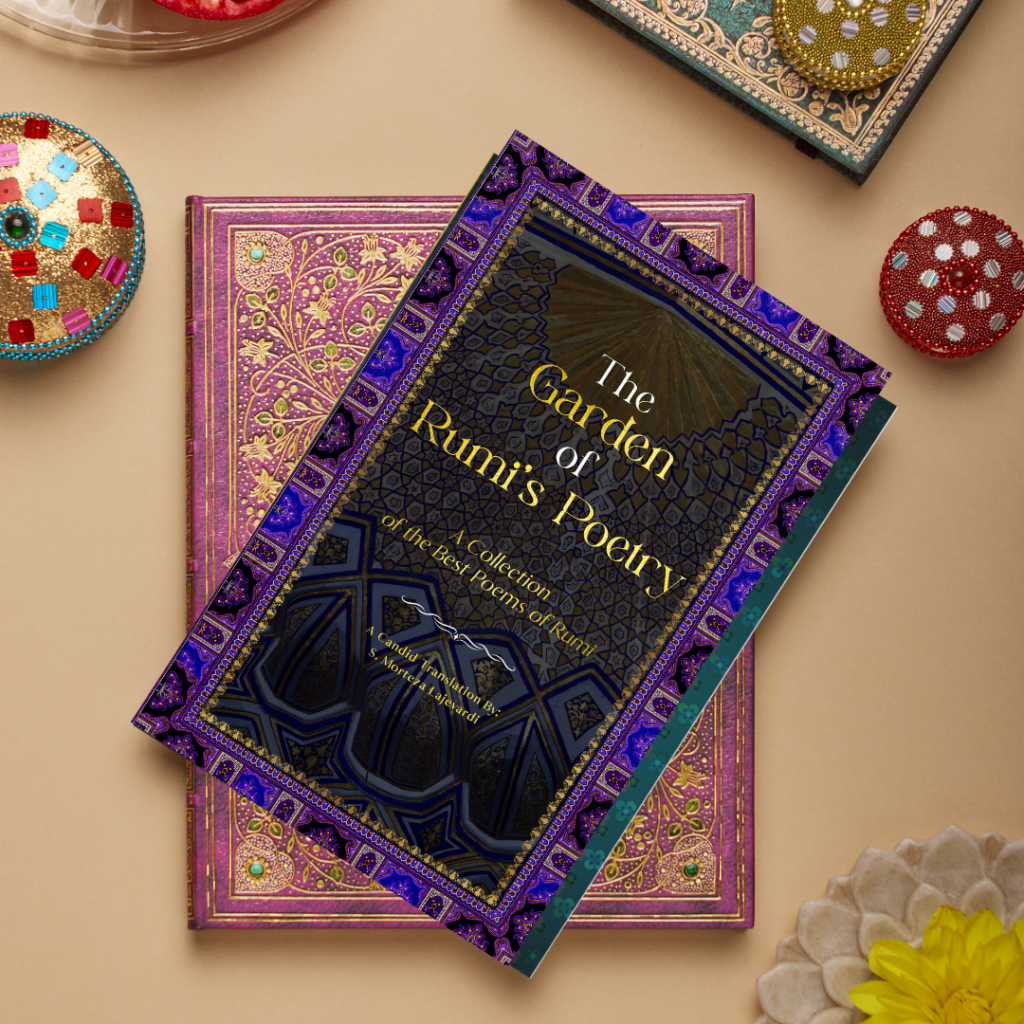
An excellent starting point is The Garden of Rumi’s Poetry, a collection of selected poems that introduces readers to Rumi’s reflections on love, the soul, wisdom, and the Divine. Readers who want to explore Rumi’s spiritual poetry more deeply can also discover other Rumi collections from the Peace and Love Institute.
Let Rumi’s Poetry Unfold Slowly
There is no need to understand every line of Rumi’s poetry immediately. His poems can be returned to again and again, and their meaning may change as our own experiences and understanding deepen. A verse that seems mysterious today may speak clearly to you at another moment in your life.
Read Rumi with curiosity, patience, and an open heart. Pay attention to his symbols, but also notice what happens within you as you read. Rumi’s poetry invites us not only to think about love, the soul, and the Divine, but to experience these questions more deeply within ourselves.
